
Finding Shoreline Residents by Source
Begin with the fact you can verify. For a Shoreline address, the King County Parcel Viewer can identify a parcel, and the assessor report can show the taxpayer or owner tied to it. A person’s name may instead fit the court index, a recorded deed, a professional credential, or a historical directory. Each source answers a different question. The Shoreline residents directory is therefore a route map to official records, not a single roll of every person in the city.
Ownership and residence are not the same. A situs address locates land, an owner field names the assessed owner, and a mailing address tells the county where it sends tax mail. None alone identifies every household member. Renters and people who are not listed in a public roll may never appear. Treat every date as important, especially when a file is old or a person has a common name.
- Normalize the name or address. Keep unit numbers, middle initials, former surnames, and likely date ranges in a short research note.
- Use the assessor and parcel map for an address. Record the parcel number, legal description, owner field, mailing field, and report date.
- Search the Recorder’s Landmark index by party, document number, or parcel. Open the document detail before treating a result as a match.
- Use voter, court, vital, or license tools only for the narrow purpose and access path each agency permits.
- For older Shoreline households, check city directories, property cards, census records, and museum photographs, then ask the archive for material that is not online.
A no-result screen is not proof that no record exists. Spelling, redaction, retention, date coverage, and the choice of court or custodian can all change the outcome. Note the portal, search fields, and date checked, then follow the office’s inspection or request channel.
Shoreline Residents Directory Offices
Shoreline records are split by subject and date. The city clerk keeps Shoreline government records and receives requests under the Washington Public Records Act. King County holds deeds, parcel assessments, voter administration, and most Superior Court files. State agencies keep statewide court indexes, vital records, archives, and professional credentials. This division matters because Shoreline incorporated in 1995. Files from the earlier unincorporated period often belong with King County or the regional archives rather than City Hall.
King County Recorder's Office
King County Customer Service Center
Seattle, WA
206-477-6620
Shoreline Address and Parcel Clues
King County offers two connected tools for Shoreline property research. eReal Property accepts a parcel number, a property name, or an address. Its report separates parcel facts from the taxpayer mailing record. Parcel Viewer accepts an address, parcel number, or condominium name and places the parcel among nearby lots. It can select adjacent parcels, draw a buffer, and export map results, but its lot lines are approximate.
The official eReal Property search shows the entry screen used to reach a property account.
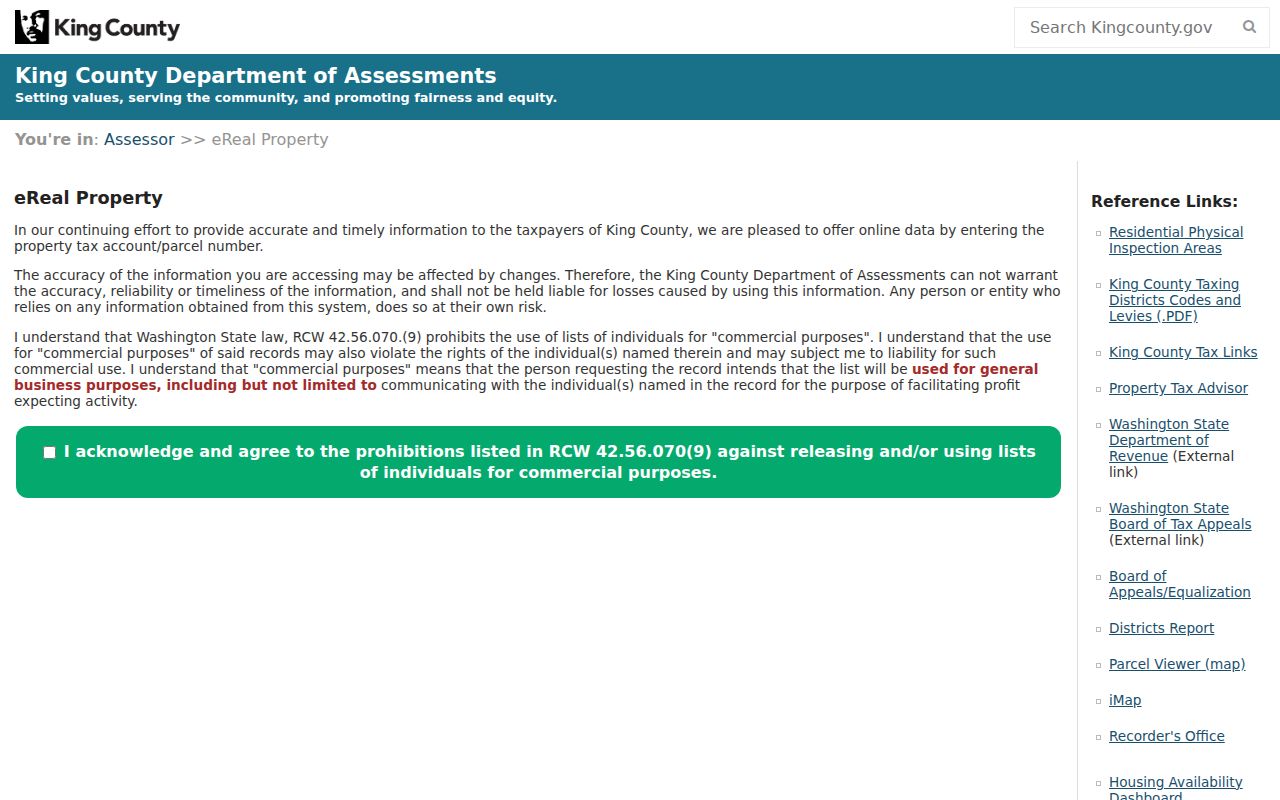
The screen is the best first stop when a Shoreline street address must be tied to a parcel and assessed owner.
- Parcel
- A county-assigned identifier for a piece of land.
- Situs address
- The location of the property, which may differ from the tax mailing address.
- Roll
- An official list maintained for a defined public purpose, such as assessment or voting.
- Index
- A finding aid that points to a record; it is not always the certified record itself.
Shoreline Permit Records by Era
Shoreline’s permit trail has three practical periods. The city’s eTRAKiT system covers records from 2001 forward. Planning and Community Development routes 1995 through 2000 files through a city records request. Work from before incorporation belongs to King County’s historical permit trail. A current Shoreline address should therefore be searched under both the city and its former unincorporated county jurisdiction when the project date is not known.
eTRAKiT exposes permit, project, and property searches. Visible controls include a Search By field, an operator such as Contains, Begins With, Equals, At Least, or At Most, and a value box. Project searches add type, name, address, owner, applicant, parcel, and date filters. Results can include attachments, inspections, reviews, fees, and related records. Public searching does not require the professional account used to submit an application.
| Search control | How it helps |
|---|---|
| Address or parcel | Anchors work to a Shoreline site |
| Owner or applicant | Finds a named role in a project file |
| Permit or project number | Returns a known record directly |
| Date filter | Keeps similar results in the right period |
Note: A permit contact or owner field records a role at one point in time and does not prove current residence.
Current Shoreline Residents Directory Sources
Modern public records list people because they own land, register to vote, record an instrument, file a case, hold a credential, or appear in another defined public role. They are not a compiled household list. The source date and purpose must remain attached to every result. The table shows the strongest starting points for a Shoreline residents directory search and the main limit of each one.
| Source | Who It Lists | Keeper | Access |
|---|---|---|---|
| eReal Property | Assessed owners and taxpayers | King County Assessor | Free public portal |
| My Voter Information | The voter making a permitted self-lookup | King County Elections | Three of four identity and address fields |
| Landmark | Parties named on recorded instruments | King County Recorder | Free index and available images |
| Washington Courts | Parties in public case-index entries | Administrative Office of the Courts | Reference index; court file controls |
| Neighborhood associations | Public civic contacts, not household rolls | City and each association | Published contact details vary |
The Shoreline resident lookup workflow explains how to compare one person across these systems without merging unrelated same-name results. For a street, move from parcel to owner to recorded document. For a name, add a middle initial, year, court level, document type, or other safe fact before deciding two entries concern the same person.
Shoreline Deeds in Landmark
The King County Recorder’s Landmark system is the official index for recorded documents. Search tabs accept names, document details, and parcel or legal-description facts. A result can show the grantor and grantee, instrument number, recording date, document type, parcel or legal description, and an image or detail link when one is available. The index is especially useful after eReal Property supplies a parcel number and owner spelling.
King County Archives describes online index coverage from 1976 forward, while older recorded material may require microfilm or staff help. Some older indexed images are not available through the public web screen. Copies can be obtained through the Recorder, and a certified copy has a formal seal or attestation that a screen image lacks. Historical requests should include the parties, date range, instrument type, and any book, page, parcel, or legal-description reference.
The Landmark recorded-document search displays the name, document, and parcel paths used for Shoreline deeds.
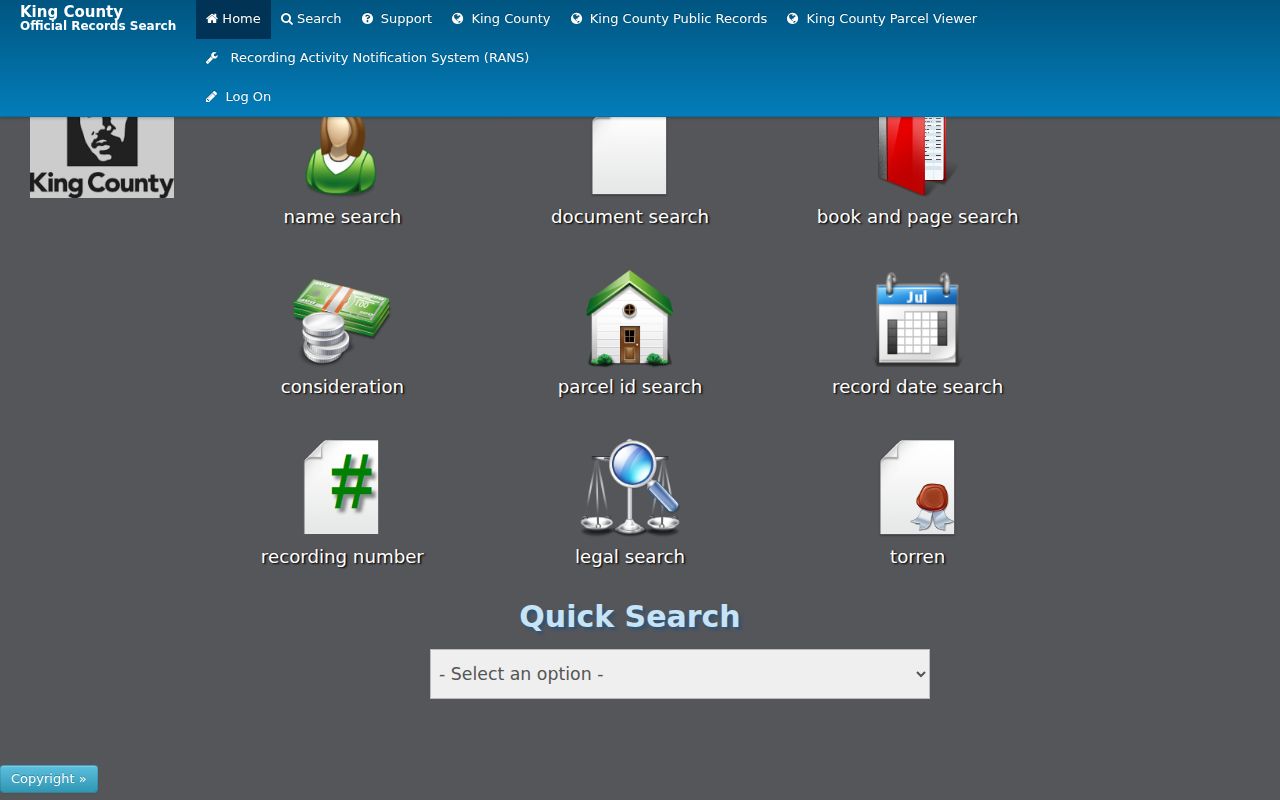
Those separate tabs let a Shoreline search shift from an uncertain name to the more stable parcel and legal-description trail.
Shoreline Voter Lookup Limits
King County My Voter Information is designed for a voter’s own registration and ballot details. It requires three of four facts: first name, last name, date of birth, and house number. The service notes that its information is updated daily. It should not be treated as a browseable street roll or a way to discover protected addresses. Washington law places limits on voter-list use, and Address Confidentiality Program records receive added protection.
The My Voter Information form shows the identity and address checks used before a record is returned.
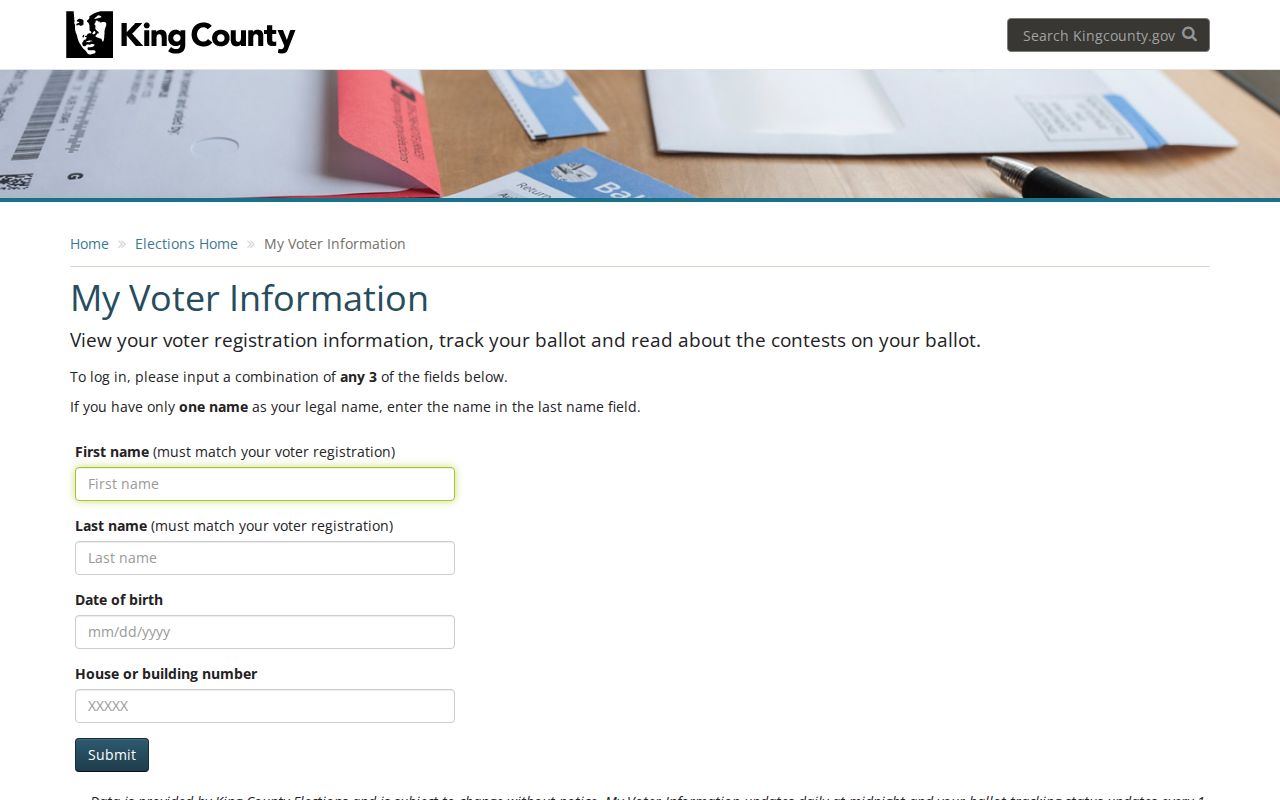
The form is a narrow verification route, not an open list of Shoreline residents.
Shoreline Court Record Checks
Washington Courts Name and Case Search provides a statewide reference index with court level, county or division, case type, party name, case number, and filed-after controls. A Shoreline municipal or district matter may require the King County District Court division filter, while Superior Court matters lead to the King County Clerk. The online result is not the official case file and may omit sealed, confidential, or retention-limited material.
Use the court, filing year, case type, full name, and a second non-sensitive fact to resolve a same-name result. The JIS-Link manual’s sample cards show fields such as case number, title, court, filing date, parties, detail, and docket or proceedings. A docket is the chronological list of events and filings in a case. To inspect or order a Superior Court record, use the KC Script Portal, the clerk’s in-person service, or the correspondence desk.
Note: A court index match proves only that a similar name appears in the index until the official file confirms identity.
Historical Shoreline Residents Directory Trails
Shoreline’s older households appear within wider Seattle and Puget Sound collections because the city did not yet exist as a municipal custodian. Seattle Public Library provides digitized city directories from 1867 through 1940, and Seattle Municipal Archives describes directory holdings from 1890 through 1990. Later reverse directories can place a listed householder at a street address. Coverage is scattered, so a missing year or suburb entry should send the search to another collection rather than end it.
The Washington State Archives Puget Sound Regional Branch holds King County property cards, assessment rolls, census records, voter registers, probate, marriage, recording, and directory material. Property cards cover 1937 through 1972 where held. King County Archives supplies older county files, while the Shoreline Historical Museum offers photographs and local collection help. The museum’s Photo Finder reported 2,071 scans online as of May 18, 2024, with dated homes, roads, businesses, people, the Interurban, Echo Lake, and Richmond Beach among its subjects.
A directory entry is a dated lead, not proof of a full household. Abbreviations may show a name, spouse, work or occupation, address, and whether a person was listed as a householder. A criss-cross directory reverses the usual order, placing streets and house numbers before names. The full collection and reading method appear in the Shoreline city directory.
Shoreline Records Before 1995
The strongest local rule is simple: match the record date to the government that existed then. Shoreline incorporated in 1995. Before that date, the area was unincorporated King County. A current Shoreline mailing address does not mean an old road, assessment, permit, election, or land file was created by the city. Write both labels in the research note: “current Shoreline” and “formerly unincorporated King County.”
Historic names can matter as much as modern house numbers. Richmond Beach was platted in 1890, the Great Northern Railroad arrived in 1891, the Interurban trolley followed in 1906, and North Trunk Road brick work dates to about 1912 through 1913. Older photographs or directory entries may use a rail stop, plat, neighborhood, or road name. Keep that wording next to the normalized current address when searching Archives, recorded documents, city directories, and museum captions.
For a property-card request, assemble the parcel number, legal description, tax year, current and former street names, and likely township, section, and range. That small packet gives archives staff a much better target than a broad request for all material about an address.
Requesting Shoreline City Records
When a city file is not in a public search, use Shoreline’s request portal under the Washington Public Records Act, RCW 42.56. The City Clerk’s page says the city will respond within five business days by providing the record, giving a reasonable estimate, asking for clarification, or identifying a lawful exemption. A request should name the department, subject, address or project number, record type, and date range. Ask for an existing record, not a newly compiled list of residents.
The Shoreline public-records portal provides the city’s intake route.
The form works best with a focused description that lets staff identify the correct department and date range.
City Clerk and Public Records Officer contacts are at Shoreline City Hall, 17500 Midvale Avenue North. The Public Records Officer can be reached at 206-801-2231 or prr@shorelinewa.gov. The city warns that personal information placed in a request may itself be disclosable. Leave out Social Security numbers, full birth dates, protected addresses, and other details the search does not require.
Shoreline Vital and Family Records
Washington vital records use access rules rather than an open resident search. Birth and fetal-death records become archival after 100 years. Death, marriage, and divorce records become archival after 25 years. Current certified birth and death certificates require a qualified applicant, identity documents, and a permitted relationship or eligibility basis. Anyone may request a marriage or divorce certificate under current Department of Health rules, but the department issues a certificate, not a divorce decree.
Historical King County marriage research changes custodians by era: Probate Court for 1852 through 1891, County Clerk for 1891 through 1947, Auditor for 1947 through 1969, and Recorder from 1969 forward. The Washington State Digital Archives indexes King County marriage material from 1855 through 2017. Probate, census, school, directory, and obituary sources can add family context without turning a single index match into a claim of current Shoreline residence.
Shoreline Privacy and ACP
Washington’s Address Confidentiality Program substitutes a designated mailing address for survivors and other eligible people who need their location shielded. Voter confidentiality statutes and court sealing rules can also remove or restrict material that might otherwise appear. In 2026, the Secretary of State marked the program’s thirty-fifth anniversary, a reminder that safe access and public access must work together.
Do not infer a protected address from nearby parcels, relatives, recorded contacts, or an old directory. Do not republish a living person’s address merely because an official index exposed it. Save the source name and date, keep only the facts needed for the lawful task, and correct errors with the agency that owns the record. The Shoreline residents directory should remain a path to official sources, not a copied database of private lives.