
Shoreline Resident Lookup Sources
No city agency keeps one open list of everyone who lives in Shoreline. Instead, a resident lookup joins narrow records created for separate public tasks. The King County Assessor connects a parcel with taxpayer and property facts. Washington Courts publishes a reference index of cases. King County Elections offers a self-lookup for registered voters. Vital records confirm life events only under the access rules for that record type.
| Record | What It Can Confirm | Custodian | Access Route |
|---|---|---|---|
| Parcel report | Taxpayer, parcel, situs address, land and building facts | King County Assessor | eReal Property, with Parcel Viewer as the map route |
| Court index | Case number, court, type, parties, and filing date | Washington Courts or filing court | Name and Case Search; documents from the court |
| Voter self-lookup | Registration information, ballot status, and contests | King County Elections | My Voter Information |
| Vital record | A recorded birth, death, marriage, or divorce event | Washington Department of Health | Certificate, information copy, or archive route based on eligibility and age |
| Recorded instrument | A person's role as grantor, grantee, or other party | King County Recorder | Landmark, then a copy request if needed |
| Public filing | Business role, credential status, or unclaimed property lead | Washington state agencies | Agency-specific search and document request |
Choose the first source by question, not convenience. An address question belongs with parcel and recording systems. A court result belongs with the court that filed the case. A family-history question may need a vital record or archive. Keep the role precise: an owner, taxpayer, voter, party, registered agent, or permit contact is not automatically a current Shoreline resident.
Search Shoreline Court Names
The Washington Courts search landing page leads to a statewide reference index. Person search requires first and last name; a middle name is optional. Case search can be narrowed by court level, search type, King County division, case category, and filing year. Use King Superior for Superior Court matters or King County District for the district layer. Shoreline is one District Court electoral division, but the filing court still depends on the case.
The official screen shows the controls that narrow a Shoreline resident lookup. Open Washington Courts case search before reviewing the captured interface.
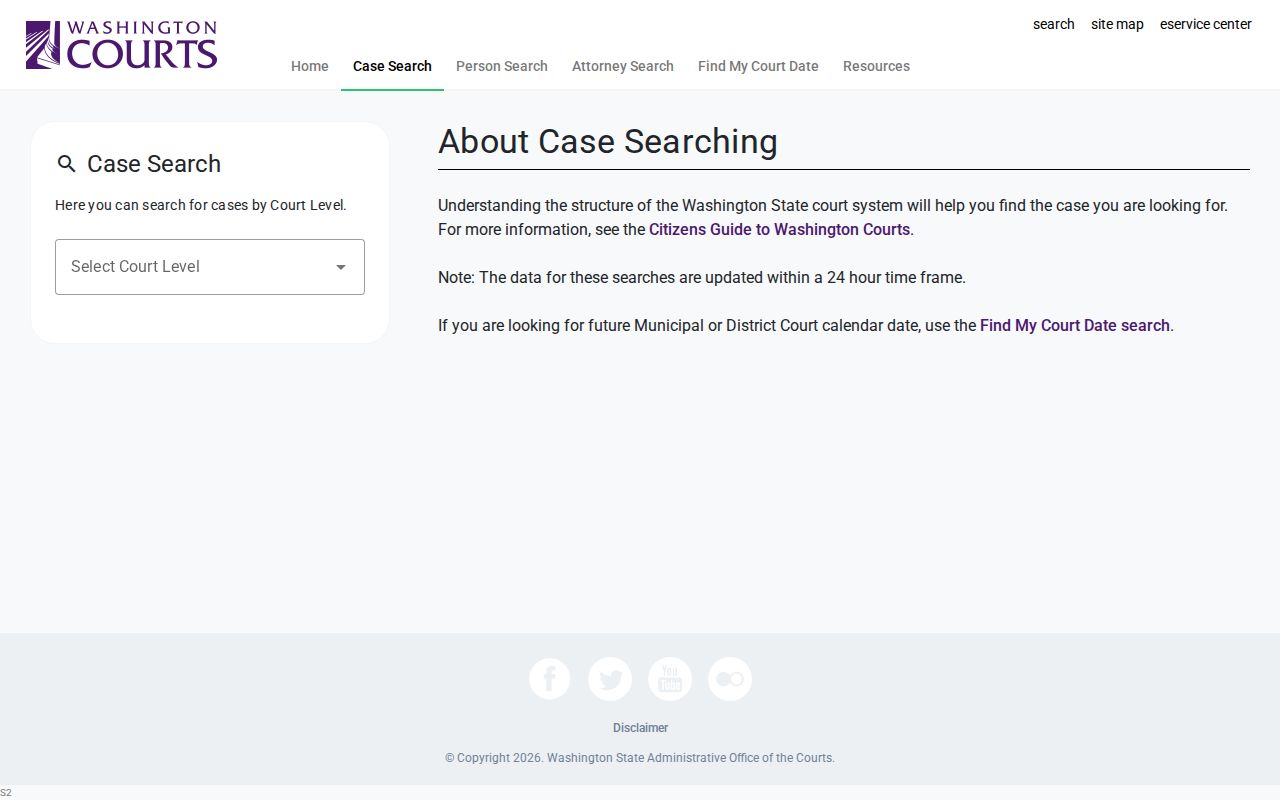
Those filters cut false matches, but the result is not an official case file. The public index updates on a schedule, omits confidential matters, and may not show a document's full text.
| Visible Field | How It Helps |
|---|---|
| First, middle, last name | Tests spelling and middle-initial differences. |
| Court level and division | Separates Superior, District or Municipal, and Appellate records. |
| Case type | Distinguishes civil, criminal, domestic, probate, guardianship, traffic, and small-claim categories. |
| Year filed | Limits a common name to a useful time span. |
| Case number | Provides the key needed for an official request. |
Resolve Shoreline Name Matches
A common name can produce several unrelated King County entries. Check the middle name or initial, court level, case type, filing year, and one other non-sensitive fact before associating a result with someone. Never use a full birth date, private contact detail, or protected address as public copy. If the index offers only a name, date, and case type, obtain the file from the custodian before describing what happened.
Does a matching name verify a person? No. It is a lead that must be compared with the official file and another reliable fact. A spelling variation or stale index can also hide a valid result.
Record the search fields and date when nothing appears. The custodian may apply different retention, spelling, redaction, or access rules. A no-result screen is not proof that no record exists.
Note: Link a court result to a person only after the court, date, role, and another non-sensitive attribute agree.
Confirm Shoreline Court Records
King County Superior Court documents come through the Clerk, not from the statewide index. The Superior Court records-access page explains the KC Script Portal, in-person inspection, copy service, and correspondence desk. This fallback matters when the public index has a party name but not the document needed to confirm identity or disposition.
The county page shows both digital and clerk-assisted routes. Review the source link above before using the captured page.
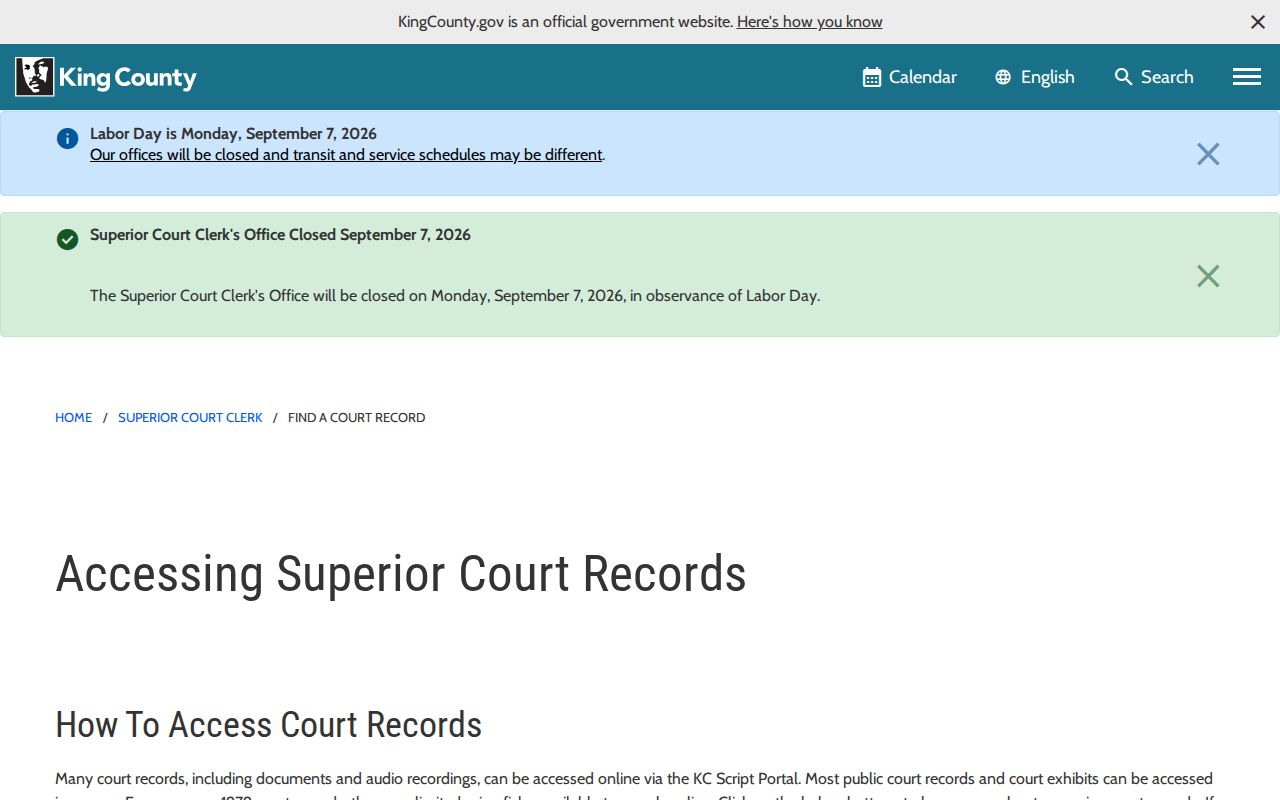
The capture reinforces a key split: the index points toward a case, while the court supplies the official record. Sealed and confidential material remains unavailable under court rules.
Verify Shoreline Resident Records
A careful Shoreline resident lookup builds a short chain of agreement. Begin with the least sensitive public fact and preserve the source's exact label. A taxpayer name on a parcel is an ownership or tax fact. A party name on a deed is a recorded role. Neither should be rewritten as proof of occupancy.
- Normalize the name and note any middle initial, former name, or spelling variant supported by a source.
- Use King County Parcel Viewer if an address is known, then record the parcel number and municipal jurisdiction.
- Check Landmark for an instrument tied to the person or parcel. Read grantor and grantee roles first.
- Search the court index with the full name, King County division, case type, and useful filing year.
- Request the official image or certified copy when the conclusion depends on document text.
For a whole road rather than one person, the Shoreline street directory explains the address-first method. That workflow keeps adjacent parcels and the deed chain separate from a one-person search.
- Docket
- The dated list of filings and proceedings in a court case.
- Index versus image
- An index lists search details; an image shows the filed or recorded document.
- Certified copy
- A custodian-issued copy marked as a true copy of the official record.
Shoreline Voter Self-Lookup
King County My Voter Information is built for the voter's own permitted lookup, not for an open resident list. It asks for any three of four fields: first name, last name, date of birth, and house or building number. First and last names must match the registration. Someone with one legal name enters it as the last name.
The form makes its identity-and-address design clear. Open the source link to check the current fields before viewing the saved capture.
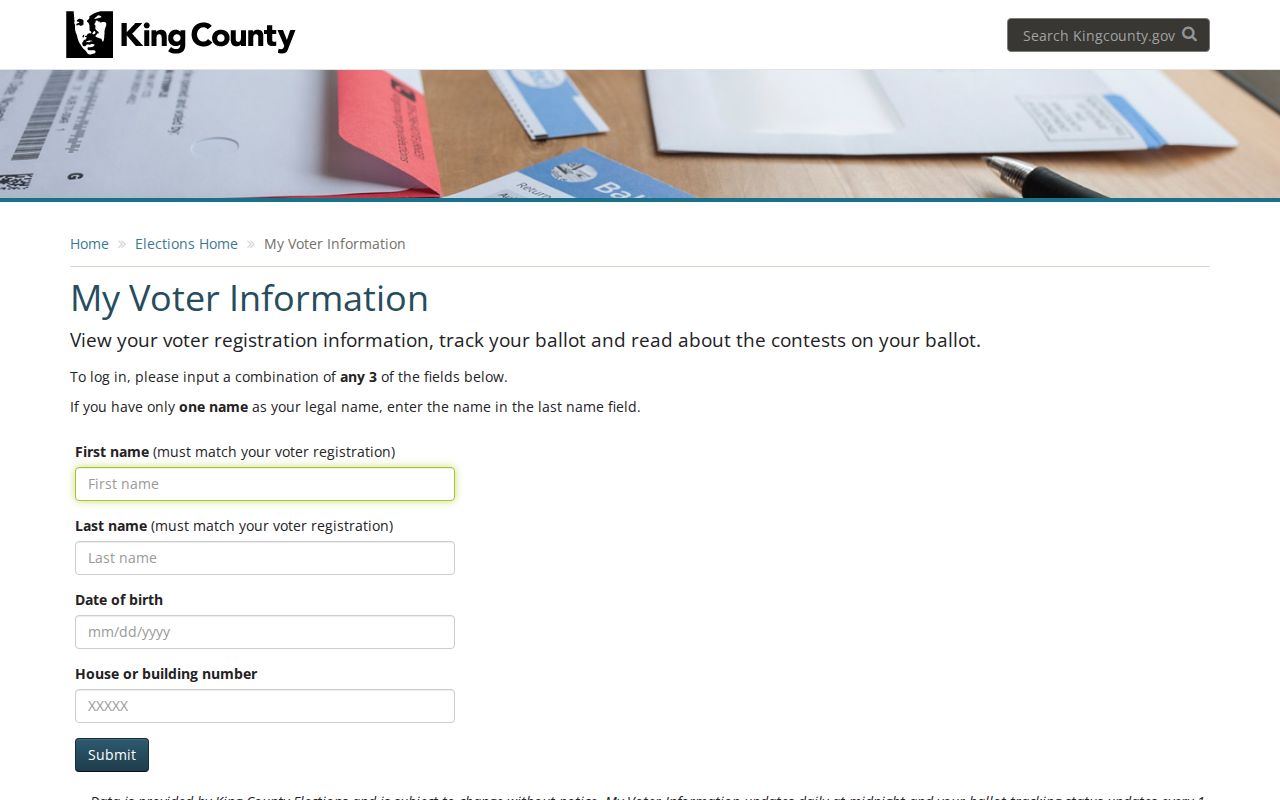
Registration information updates daily, while ballot status updates more often during the day. Do not freeze a result as permanent fact. Washington law restricts advertising, offers, and solicitations based on voter-list data, so use the system only as authorized.
Shoreline Vital Record Paths
The Washington Department of Health keeps current certificate routes. Birth and death records have qualified-applicant, identity, and relationship rules. Marriage and divorce certificates follow different access terms. DOH issues a divorce certificate, not the court's decree. For a decree, contact the court that entered it.
Archival age changes the route. Birth and fetal-death records become archival after 100 years. Death, marriage, and divorce records become archival after 25 years. The Digital Archives King County marriage collection covers 1855 through 2017, making it useful for family history without treating an entry as present residence.
Current orders can be made online, by mail, or through a local health department where offered. For an heir or family link, identify the event, year, county, and relationship before choosing a certificate or archival copy.
Shoreline Public Filing Clues
State filings can confirm a defined public role. The Corporations and Charities Filing System searches a business name or UBI and offers filters for status, entity type, dates, registered agent, and governor. A result may name a person in an organization record, but it does not prove that person lives in Shoreline.
The credential search can confirm type, issue date, status, expiration, and public enforcement documents. Washington's unclaimed property search accepts name, city, ZIP, and property ID. It can help reconnect a relative or identify an estate lead, yet the city or ZIP field may be old.
Keep the purpose narrow. A filing verifies the role stated by its agency. Record status and access date, then use another source if the question concerns identity or current location.
Request Shoreline Resident Records
When a name appears in a permit, hearing, or council matter but the file is not online, use the City Clerk public-records instructions. Within five business days, the agency must provide records or a link, acknowledge the request with a reasonable estimate, or deny it with a stated reason. That rule does not promise production within five days.
Ask for a date range, address, parcel, permit or project number, and document type. Avoid a broad request for every record about a person. The city warns that details entered into a request may themselves be disclosable, so omit full birth dates, Social Security numbers, health facts, and needless private contact data.
For post-2001 permit material, search eTRAKiT first. Records from 1995 through 2000 use the city disclosure route; pre-incorporation permit files belong with King County. This jurisdiction check often explains a Shoreline no-result.
Limits on Shoreline Lookup
Public does not mean complete. Court indexes omit sealed matters. Vital records have eligibility and archive rules. The Washington Address Confidentiality Program can replace an eligible participant's actual address in government records. Created in 1991, the program protects people facing serious safety risks. Certification lasts four years and must be renewed.
A protected person may be absent from a source that would normally return a record. Do not infer the missing address, combine sources to reconstruct it, or republish information about minors, victims, health, or private accounts. Corrections belong with the agency that holds the record.
Lawful use. Use a Shoreline resident lookup for lawful personal research. Never use a result to stalk, harass, threaten, or harm anyone.
Note: A public record can be accurate about a past event and still be wrong as evidence of where a person lives today.